

While the Bigger Stories Develop, A Few Important Updates
State regulators are filling communication gaps while City Council weighs a nearly full-year “Other Expenses” request during the temporary budget period.

I’ve been working on several in-depth pieces about Trenton Water Works that require OPRA responses and interviews with subject-matter experts. Those take time. Rather than go quiet while that reporting develops, I want to share a few smaller — but meaningful — updates that deserve attention.
DEP Continues Filling in the Public Information Gaps
Last week, I noted that NJDEP has begun regularly updating its “Additional Information and Letters” page with operational updates about TWW. Unlike TWW’s press releases — which are directed primarily to media outlets and public officials in the hope that they trickle down to customers — the DEP updates are written plainly and aimed directly at ratepayers. Here is DEP’s update from Friday, February 27:
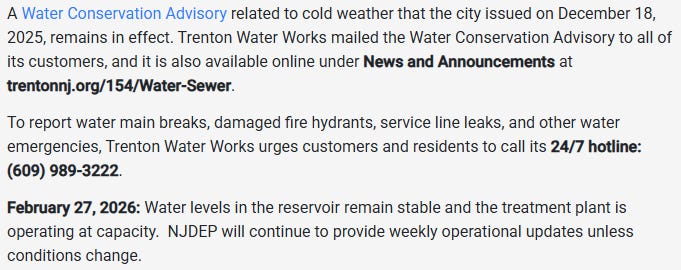
Two things stand out. First, DEP remains committed to weekly updates unless conditions materially change. It reflects an acknowledgment that customer confidence requires consistent, reliable communication.
Second, DEP continues to remind customers that the system remains under a Water Conservation Notice. That reminder has been absent from TWW’s communications. TWW issued a conservation notice on December 18, but it has not been emphasized since. In fact, if you follow the link DEP provides to TWW’s conservation notice, the page appears to have been removed.
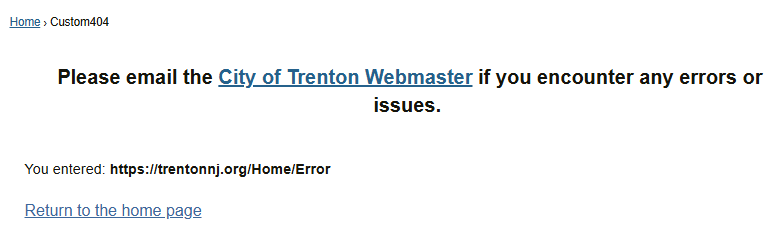
Update: As of Monday afternoon, the link to TWW’s Water Conservation Notice was fixed.
Conservation messaging is not comfortable messaging. It signals stress in the system. But transparency is not about comfort — it is about accuracy. When a utility relies heavily on public confidence, there may be a temptation to minimize anything that sounds like instability. The problem is that selective reassurance ultimately erodes the very confidence it is meant to protect.
TWW Emergency Budget Appropriation
On December 2, 2025, City Council adopted a temporary budget for TWW. Under state rules, municipalities may authorize a temporary appropriation of roughly 25% of the prior year’s budget — about three months — while the full annual budget is being prepared. That is routine and appropriate. For TWW, that temporary authorization totaled approximately $11 million. The line item worth examining is Water Utility – OE (Other Expenses).
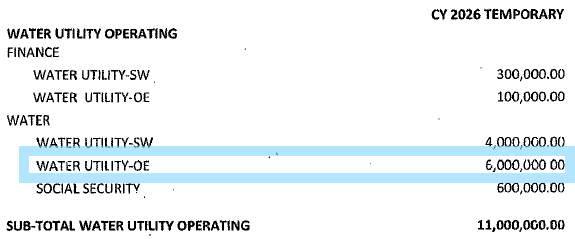
Looking back at the adopted 2025 annual budget, “Other Expenses” totaled roughly $25 million of the $60 million utility budget. In other words, more than 40% of TWW’s annual budget sits inside a single, broad category labeled “Other.”
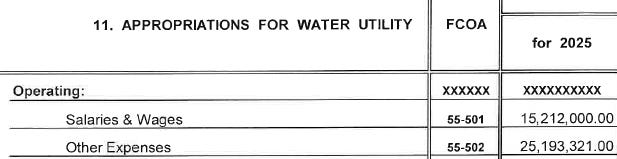
That structure echoes concerns raised in DEP’s consultant reports about financial transparency. The TMF review noted that the accounting data available made multiyear operating comparisons “very difficult.” When nearly half of the budget is consolidated into one category, that difficulty is easy to understand.
“The accounting and financial data available for review is limited and in a format that makes multiyear comparisons of the budgets, particularly the operating budgets, very difficult…”
But that broader structural issue is not today’s focus. Instead, attention turns to this week’s City Council agenda. A resolution is being introduced to authorize an emergency appropriation to the temporary budget.
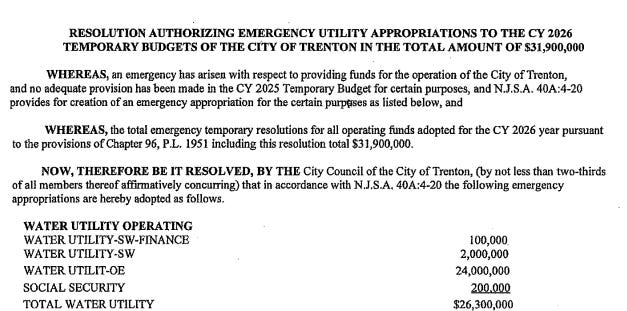
Within that request, TWW is seeking approximately $24 million for the OE line item.
To put that in perspective, $24 million represents roughly 96% of the entire 12-month OE budget from 2025 — requested during the temporary budget period.
There may be reasonable explanations. Certain expenditures can be front-loaded. Annual chemical purchases, bulk contracts, or large service agreements may come due early in the year. If so, that should be explained clearly.
But when a temporary budget appropriation nearly equals an entire prior-year annual allocation for the same line item, it warrants scrutiny.
The Questions Council Should Be Asking
City Council functions as the governing body for TWW. In practical terms, it serves as the utility’s Board of Directors. If I were sitting on that dais, I would want:
A detailed breakdown of what comprises the $24 million request
A projection of remaining OE spending for the balance of the year
A cash-flow analysis tied to the expected rate revenue
A clear explanation of whether this is a timing issue or a structural increase
Last year, TWW generated roughly $7 million in surplus revenue — including the City’s $2.6 million transfer to the general fund. If OE spending materially increases beyond prior levels, the questions become unavoidable:
Does this jeopardize the $2.6 million annual transfer?
Does it reduce reserves needed for capital work?
Could it place the utility on a path toward requesting a taxpayer subsidy later in the year?
These are not accusations. They are governance questions. An emergency appropriation that large — during a temporary budget period — should come with transparent documentation, detailed schedules, and a forward-looking financial projection. Anything less leaves Council voting in the dark.
Thank you for the research and quick looks. If I read this right, 2025 operating expenses were approx $40.4M. If Trenton extracts $2.6M, that's 6.4%. This is more than 3x what we were told during presentations to townships last Sep, that the city extracts 2%. It's still not clear why Trenton is allowed to tap TWW funds...