

Regionalization ≠ Privatization
Why Restructuring Trenton Water Works is About Public Safety, Not Selling Out

When the word “regionalization” comes up in Trenton, it’s often met with suspicion — or worse, outright misinformation. Some city officials have even tried to convince residents that regionalization is just a backdoor route to privatization.
It’s not.
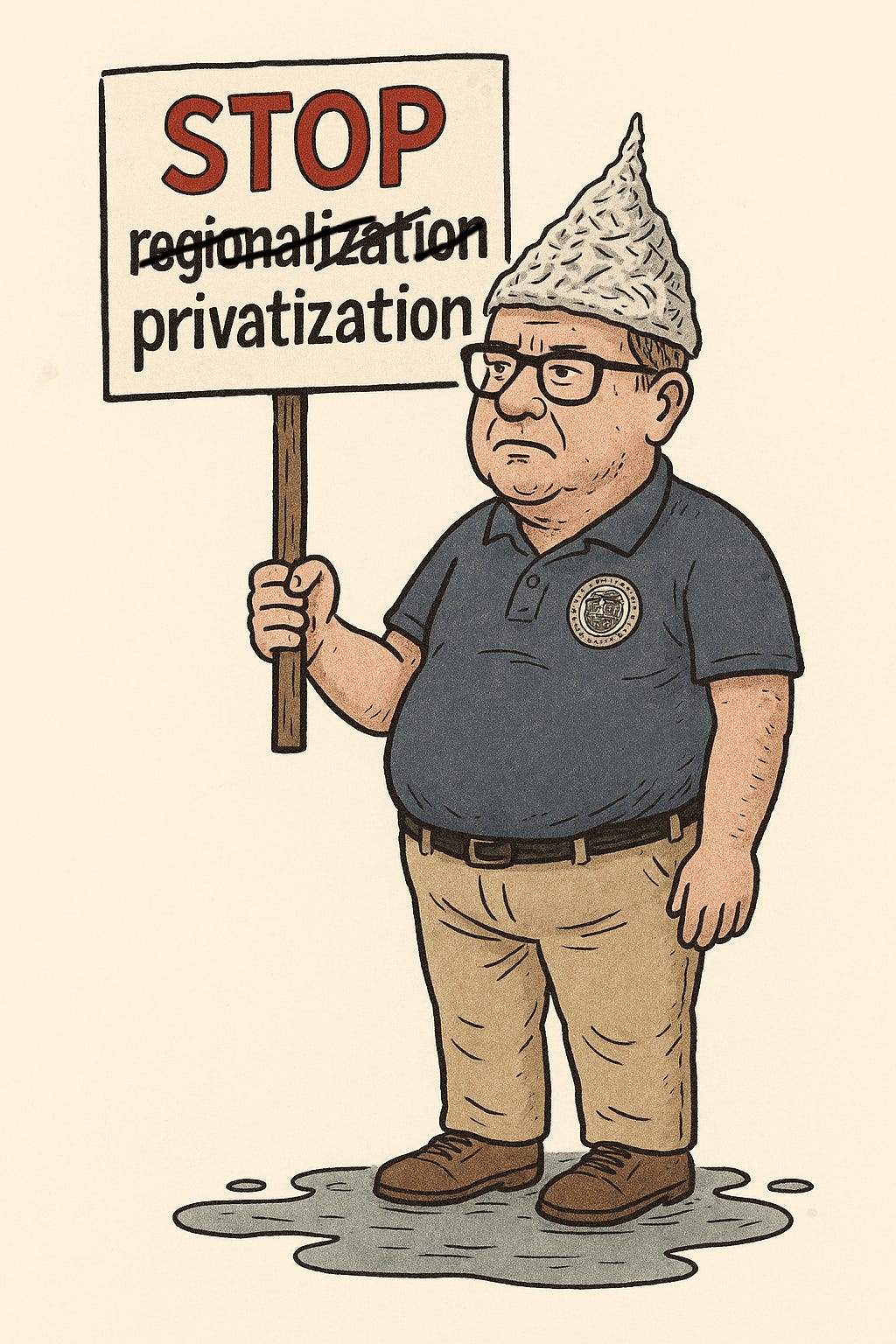
This post will explain what regionalization actually means, why it's fundamentally public, and how it would prevent the kind of political interference that has repeatedly crippled Trenton Water Works (TWW).
What Regionalization Doesn't Mean
It’s not privatization. Regionalization is not a sale to a private water company.
It’s not a cash-out deal. The goal isn’t profit — it’s reliable service and public health.
It’s not an outsider takeover. It’s a shift toward shared governance among municipalities that all depend on the same water system.
What Regionalization Does Mean
The DEP-funded 360° Review and TMF Evaluation outline several potential governance structures, including:
A regional Municipal Utilities Authority (MUA) — a publicly governed utility with shared control by Trenton and surrounding towns.
A Special Purpose Entity (SPE) — a standalone public body designed for long-term, transparent operation.
A Public-Public Partnership (PUP) — where a successful public utility helps operate a struggling one, under public ownership.
Each of these options keeps control public, but distributes it more evenly — reducing the chance that any one city government can act as a bottleneck or political spoiler.
Why This Matters: Political Gridlock Has Already Cost Trenton Residents
This isn't hypothetical. A few years ago, a dysfunctional Trenton City Council blocked contracts needed to access lead service line replacement funds, delaying urgent infrastructure work. The result? TWW missed its chance at state funding and fell even further behind in protecting residents from lead exposure.
That kind of self-sabotage was only possible because TWW is wholly under City of Trenton control. In a regional structure, no single city council could stall life-saving progress for political reasons. Governance would be shared — and decisions would need to meet regional performance and transparency standards.
Regionalization Works: Real Examples in NJ
New Jersey already has strong models of successful regional utilities:
Passaic Valley Sewerage Commission serves 1.5 million people across 48 municipalities.
Brick Township MUA manages water for multiple communities via shared public infrastructure.
North Jersey District Water Supply Commission provides bulk water to more than 3 million residents via regional cooperation.
These entities operate publicly, transparently, and professionally — with long-term planning and minimal political disruption.
Reclaiming Public Trust
Regionalization is about:
Ending chaos caused by local political interference
Ensuring accountability through broader oversight
Protecting public health with stable, professional operations
This isn’t about surrendering control — it’s about regaining it from a broken system.
If the City can’t or won’t fix this, it shouldn’t have sole power over a utility that serves over 200,000 people.
As a resident of Trenton, I’m concerned and confused about all of this regionalization talk, especially if ownership passes over without Trenton being compensated for the infrastructure that is existing. Is that the plan?