

Call to Action! Another Study, Another Delay
Three studies already agree on TWW’s future — a fourth would only delay action.

Sixty-nine days ago, the Commissioner of the New Jersey Department of Environmental Protection publicly asked Trenton City Council to take action — to support a two-year study on regionalizing Trenton Water Works.
Council has done nothing since.
Now, instead of responding to the State’s request or advancing any of the corrective actions already laid out by DEP oversight, Council is proposing to commission yet another consultant — to conduct a “comprehensive independent assessment” of the very same issues that have already been studied, in depth, by DEP and by the City’s own experts.
It sounds responsible. It’s not. It’s a stall.
The Familiar List
According to the draft resolution, the proposed study would examine:
Asset valuation
Bonding and debt capacity
Financial position and status
Capital planning
Operational capacity
Retention of the current TWW structure with enhanced oversight
Establishment of a Trenton-owned utility authority
Fiscal and legal impacts of regionalization
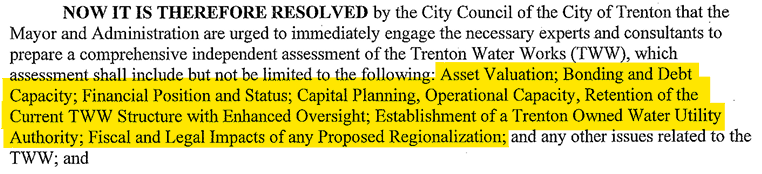
Every one of those topics has already been covered — comprehensively — in at least one of three reports completed within the last eighteen months:
H2M’s Technical, Managerial, and Financial (TMF) Capacity Evaluation, commissioned by DEP.
Black & Veatch’s 360-Degree Review, also commissioned by DEP.
The Picco Report on Staffing and Budget, commissioned by the City of Trenton itself.
If Council wants answers, they already exist.
Asset Valuation and Debt Capacity
Black & Veatch’s 360-Degree Review contains a complete asset valuation and financial model, including the value of Trenton’s water infrastructure, its outstanding debt, and its borrowing capacity.
The report quantified how transferring TWW into a new governance model could remove $128 million in general-obligation water debt from the City’s books and free up an estimated $300 million in additional bonding capacity for other needs.
That is not a political talking point; it’s a published finding in a DEP-commissioned engineering report.
Financial Position and Status
The same report concluded that Trenton’s current management and financial framework places the entire system in what DEP described as “extreme high risk.” Deferred maintenance, unreliable billing, and the City’s use of utility revenues to pad the general fund have all undermined the water system’s stability.
Picco’s independent review, commissioned by the City in 2024, makes the same observation from inside the operation. “TWW finances are in a haphazard state,” he wrote, noting the absence of an on-site budget officer, the lack of reliable recordkeeping, and an urgent need for a rate model that accurately reflects operating costs.
His solution? Retain a financial consultant to maintain that model and update it biennially. The City hired him to say exactly that.
Capital Planning
DEP’s TMF report sets the baseline for TWW’s capital program: roughly $500 million in required improvements over the next decade. The 360 Review modeled those same projects under multiple governance options.
Picco’s report goes even further, publishing a ten-year capital plan totaling $576 million in projects through 2033 — front-loaded in the early years to make up for the years of capital inaction between 2020 and 2024.
No new study will change those numbers. The need is already quantified; the question is, when will TWW be able to attract staff to manage these projects?
Operational Capacity
Where Picco’s report is most valuable — and most ignored — is in its candid assessment of day-to-day operations.
He found that Trenton Water Works lacks both the staffing and the organizational structure to sustain compliance without outside support. “Attracting and keeping qualified personnel has been a critical problem for TWW for many years,” he wrote. Residency requirements, state oversight of hiring, and the absence of a functioning training program have all left the utility “operating with outdated equipment in many areas.”
His recommendations are direct and actionable:
Increase staffing from 179 to 218 positions.
Create a Planning and Compliance Division to manage regulatory mandates and capital coordination.
Conduct a full operational survey of the treatment and distribution systems.
Abolish or regionalize the residency requirement that limits hiring — a revised ordinance we are still waiting on from Administration.
DEP’s TMF and 360 Review both reach the same conclusion: TWW’s technical and managerial capacity is rated “extremely high risk.” In other words, the problem is not a lack of information — it’s a lack of implementation.
Governance and Oversight Options
The most striking overlap among all three reports is on governance.
Picco states flatly that the City’s existing structure “does not have long-term viability,” noting that “the majority of the customers of TWW are not City residents” and that suburban customers “need to believe they have meaningful input on operational decisions which affect them.”
The 360-Degree Review translates that observation into a full comparative analysis of five governance models — the municipal status quo, a Municipal Utilities Authority, a Special Purpose Entity, a City-led public-private partnership, and full privatization. It concludes that regionalized public models like an MUA or a State-sponsored entity offer the best balance of cost control, compliance, and credit relief.
In short: the regionalization study Commissioner LaTourette asked Council to endorse has already been completed.
What This Really Means
The Council’s new “independent assessment” doesn’t fill a gap — it creates one. It pushes decision-making even further into the future, past the next election cycle, past the next round of DEP compliance deadlines, and past the patience of the 225,000 people who depend on this system.
Trenton Water Works does not need another report. It needs leadership willing to act on the reports already written.
The data are in. The recommendations are clear. The time to “study” has passed. The time to decide is now.
Wasn't this all a part of what the NJDEP COMMISSIONER recommended. I will definitely review his letter and presentation but I do recall his acknowledging the need for update on Asset valuation and bond capacity as part of the DEP's proposed study of how to regionalize TWW.